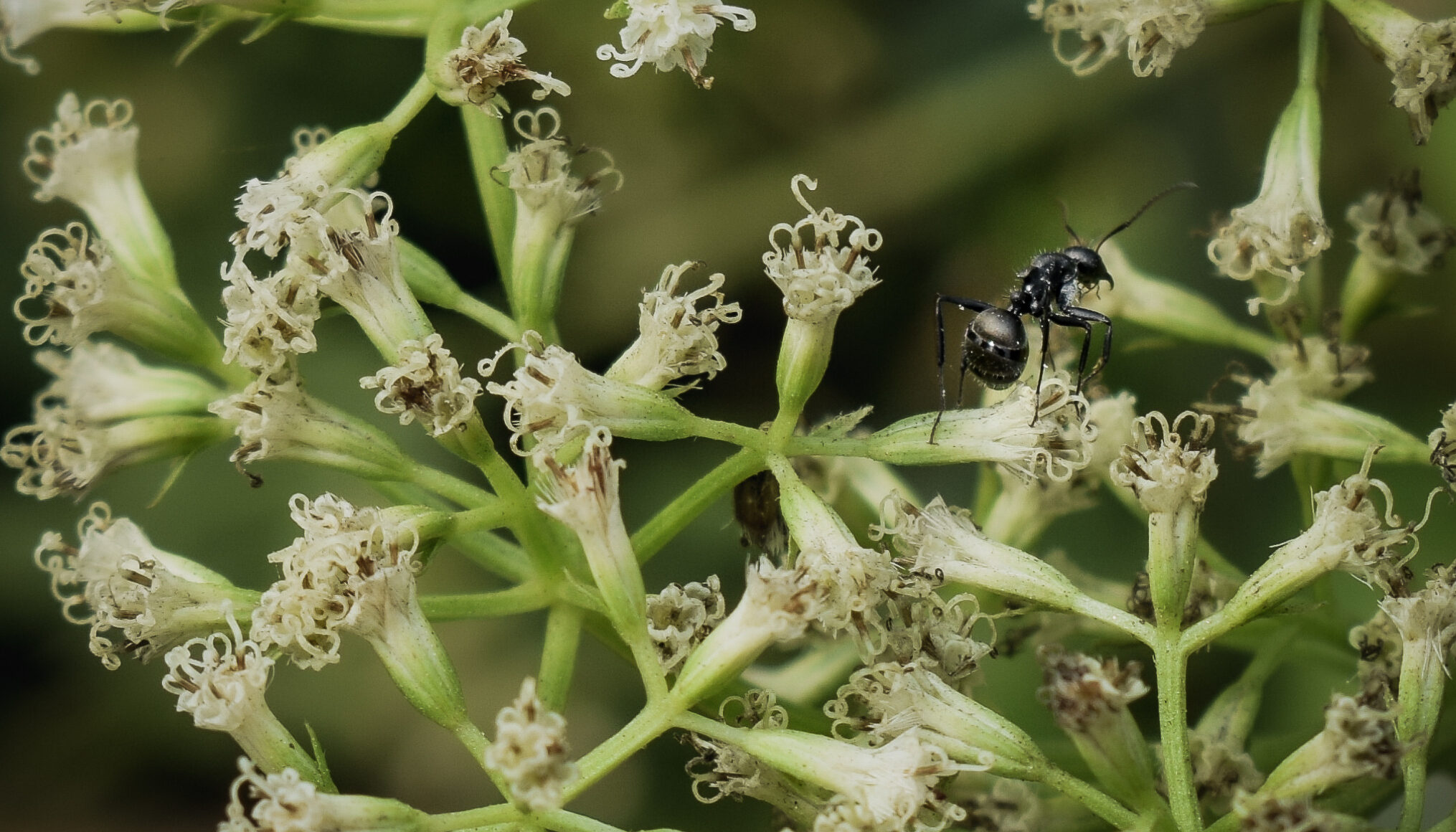
Back in 2020, as I was starting my PhD at the Indian Statistical Institute, Kolkata, I first heard about the invasive alien species. Any organism that has been brought to a place where it does not belong originally is called an alien species, and out of these aliens, ones that cause economic and environmental harm are called invasive aliens. I was given the freedom to choose my invasive alien species (or IAS, as we lovingly acronymize them) of interest, and I chose Mikania micrantha, a ‘charismatic’ IAS of Latin American origin and a global concern.
Over the next seven years or so, the species had given me ample chance to explore its distribution range, know its adverse impacts on the environment and economy, and, unknowingly, given clues on its own control measures. Research papers and articles are plentiful on these aspects if you are interested. But the most intriguing thing that I unearthed, and am going to share with you here, was the species’ journey from its home in Latin America to India, a story that remained hidden in the pages of old botanical explorations.
The journey beyond borders
Plants are sessile on their own, and we prefer them for several purposes, like food, ornamental use, agriculture, and forestry. Such human preferences help many plant species reach new places outside their home and contribute to the majority of alien species introductions. This is the first step of the biological invasion process, and for obvious reasons, restricting their journeys outside their native range is often the priority of any IAS management frameworks.
If you ask Google now about how Mikania micrantha came to India, it will tell you that
Mikania micrantha was introduced to India in the 1940s for use as ground cover in tea plantations in northeast India.
If you had googled the same question a few years back, it would have told you
Mikania micrantha was introduced to India to camouflage the airfields in northeast India during World War II.
So, the narratives change. Let me serve you another one, but with a pinch of salt: archival sources can help us know how a species ‘possibly’ reached a new place, but never with certainty. The narrative of the reconstructed journey may change again, as newer evidence comes to light.
One disclaimer: Mikania has more than 400 species, and I am not going into the species details here, just to keep the complexities away, unless necessary, from Mikania’s eventful journey from Latin America to India.
The Eastern Gateway
Meet Henry Harpur Spry, an assistant surgeon on the Bengal staff of the East India Company. Within a lifespan of only 38 years (1804-1842), Spry was elected a fellow of the Royal Society, besides being a member of the Asiatic Society and the secretary of the Agricultural and Horticultural Society of India. In 1839, Spry recommended Mikania to be cultivated in the Calcutta Botanical Garden for their medicinal values in his book Suggestions for the Introduction of Useful and Ornamental Plants into India.
What did Spry recommend? Three species: Mikania guaco, M. opifera, and M. officinalis. Among these, M. guaco was used in Jamaica as a folk medicine for anti-bacterial activity and was introduced to the Kew Botanical Garden from Jamaica in 1886 (source: Bulletin of Miscellaneous Information, Royal Botanic Gardens, Kew). This species looks very similar to M. micrantha; in fact, one of the common names of M. micrantha is ‘falso guaco’. Therefore, it is possible that this ‘falso guaco’, in place of the true guaco, was introduced from Jamaica to the Calcutta Botanical Garden, either directly or via Kew.
Such misidentifications of plant species were not uncommon at that time, when botanical imperialism in India was at its zenith. The British established networks of botanical institutions and facilitated the introduction of many plant species with commercial or medicinal value. Joachim Otto Voight, a Danish surgeon-turned-botanist, recorded the cultivated plants in the East India Company’s botanical gardens in Calcutta and Serampore. Voight died of illness in 1843 on his voyage back to Denmark, but his unfinished book Hortus Suburbanus Calcuttensis, published in 1845, holds the record of Mikania in the Calcutta Botanical Garden. But the three species he identified as Mikania were later found to be of a different plant called Eupatorium.
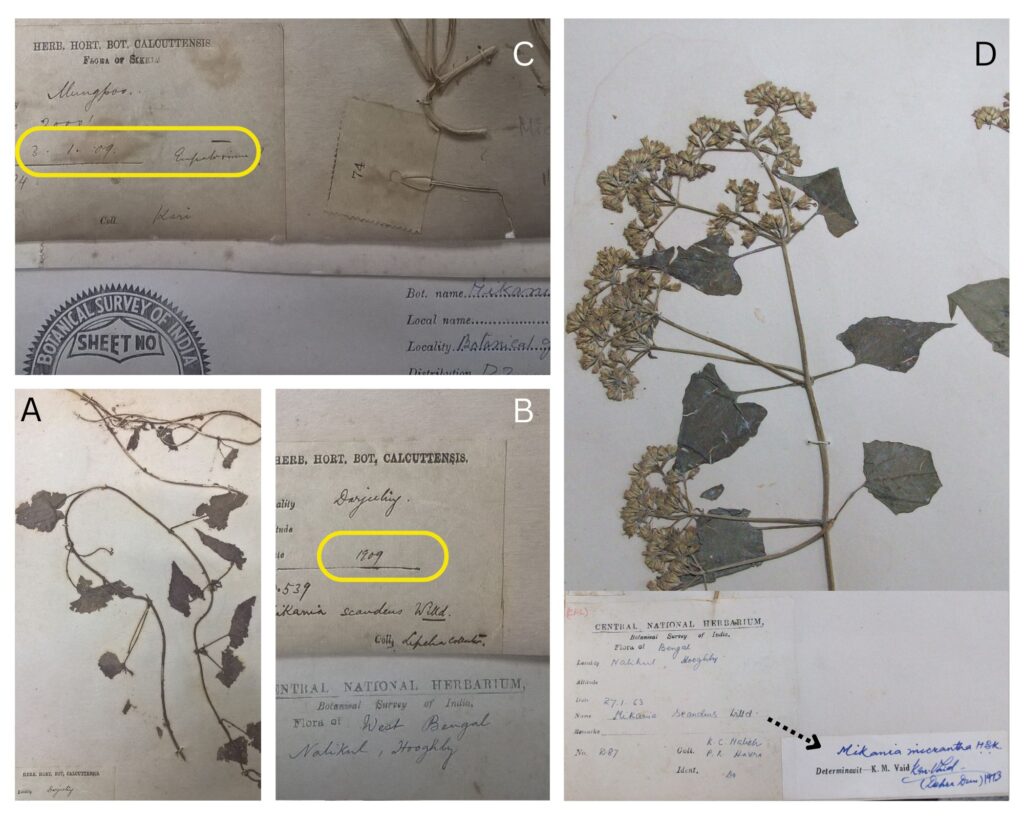
And the time? The introduction of Mikania probably happened in the late 1800s or early 1900s. In 1903, Sir David Prain, a Scottish Botanist at the Calcutta Botanical Garden who became the director of Kew, recorded the plant from Central Bengal (Calcutta and surrounding regions) in his book Bengal Plants, a book that we followed for taxonomic identification in our undergraduate studies. Then came Henry Haselfoot Haines (1867-1945), a trained British forester and then in charge of several imperial forests, who recorded Mikania in his book The Botany of Bihar and Orissa in 1922. By 1944, the plant became abundant in and around Kolkata, as observed by an Indian Botanist, Amal Bhusan Chaudhuri.
Himalayan foothills infiltrated
When Henry Spry was recommending Mikania for cultivation in Calcutta, a 30-year-old young man was leaving England to study Himalayan plants for the next three years. Sir Joseph Dalton Hooker started his expedition from Darjeeling, a tiny hamlet in north Bengal, and travelled to Sikkim, Nepal, and Assam in northeast India, before leaving India in 1850. In 1882, he published his observations in seven volumes under the name of The Flora of British India, in which he mentioned Mikania to be distributed across Arunachal Pradesh, Myanmar, Thailand, Singapore, and the Philippines.
Just a few years before this publication, in 1876, Charles Baron Clarke, a British botanist who was celebrated for his botanical collections across India and considered a recognized authority on Indian flora, recorded Mikania from eastern Assam in his book Compositae Indicae.
I found two herbarium sheets (a dried plant specimen on paper with information on its name, the place from which it was collected, the time of its collection, and other details) of Mikania from Darjeeling in the Central National Herbarium (accession numbers: 74 and 539). The samples were collected from a place called Mungpoo, a village in the Darjeeling district of West Bengal, in 1909. This is the place where Sir Clements R. Markham, a British geographer and explorer, introduced the cinchona plants from their native Peruvian forests in 1862 to combat the malaria problem among the workers in the tea plantations (Travels in Peru and India by Clements R. Markham, 1862).
At about the same time, in 1851, Alexander von Humboldt and Aimé Bonpland were publishing their Personal Narrative of Travels to the Equinoctial Regions of America. Humboldt, the German polymath, and Bonpland, the French botanist, explored South and Central America from 1799-1804. In this self-funded trip, they collected vast amounts of data on natural phenomena and plant life. Their accounts mention the anti-malarial properties of Mikania and its use by the local people of the continent.
Therefore, it is possible that Mikania was brought to India intentionally (for its anti-malarial properties) or it hitchhiked its way to India with the cinchona plants in the late 1800s or early 1900s, at about the same time when it reached Calcutta.
Passing through the latex groves
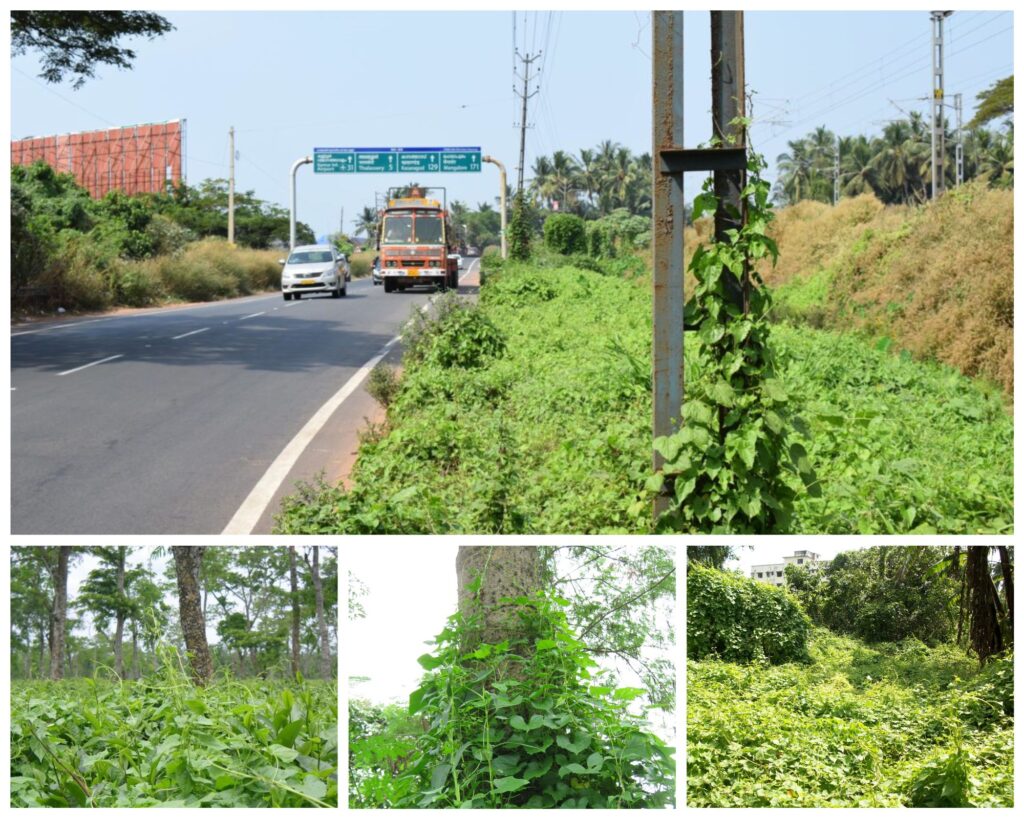
If the botanical gardens in the east and the cinchona plantations in the northeast paved the way for Mikania‘s introduction into the country, then rubber plantations facilitated its arrival in South India, albeit much later.
Commercial rubber plantation started at Thattekad in Kerala in 1902 by John Joseph Murphy (1872-1957), an Irish agricultural entrepreneur. Eight years after India’s independence, in 1955, the Rubber Research Institute of India (RRII) was formed at Kottayam district, Kerala. In 1968, just after 13 years of RRII’s establishment, Mikania was observed at one of its experimental stations, as noted by Dr. K K N Nair, a prominent Indian botanist at the Kerala Forest Research Institute (KFRI). So, how did the plant arrive here?
The answer probably lies in one of the operational strategies of the institute. Soon after its establishment, RRII established a material transfer agreement with other rubber-producing Southeast Asian countries like Malaysia, Indonesia, and Sri Lanka. Mikania was already introduced in these countries for use as a ground cover to help with soil erosion and weed suppression in rubber plantations. Archival evidence suggests that the plant was introduced in 1949 in Indonesia, 1950 in Malaysia, and 1960 in Sri Lanka.
So, it is possible that Mikania was introduced intentionally (as a ground cover) or accidentally (as a weed of rubber plantations) to southwest India from these Southeast Asian countries in the 1960s.
End note
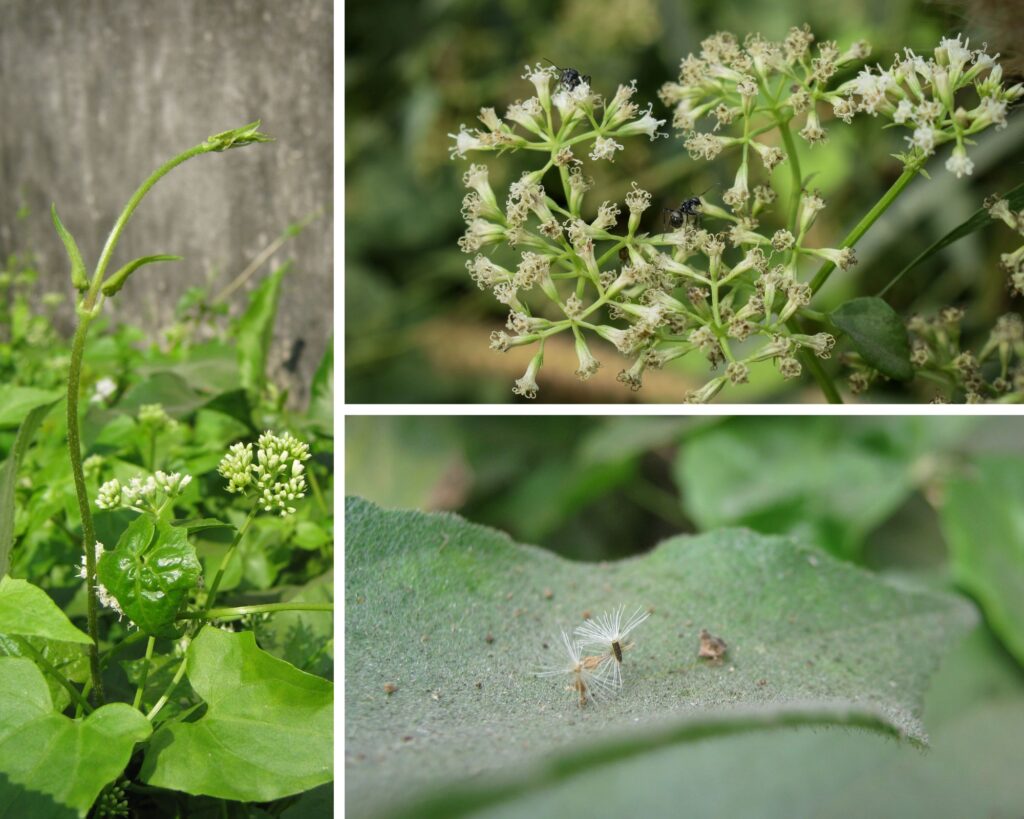
My narrative thus tells me two important things: 1) Mikania came to India not once but on three occasions, and 2) it came much earlier than 1940, the time it was previously thought to be introduced into India.
Over time, the plant has spread over a large part of the country from these three introduction sites, and has started creating problems, notably in the southwest (like in commercial plantations) and northeast (like in tea gardens) parts of the country, as it quickly creeps over and chokes the other plants (of economic interests) to death. We are now left with very few options to manage it.
The routes through which it came to India may not be operational anymore, or may be regulated more strictly than ever. But the importance of this work lies elsewhere – it should ignite searches for evidence to reconstruct the probable pathways for other IAS, challenge and verify the established notions, and fill the knowledge gaps. History taught us the consequences of unregulated movements of plant species, and we should remain vigilant whenever transporting plants between locations, regardless of the purpose.
History is supposed to teach us how to deal with the present and future, but it doesn’t do that if we look at it merely as a record of events.
Robert Hooke